“I chose not to give up”: Brigitte’s journey of healing, dignity, and rebuilding in eastern DRC

In Kiziba 2, on the outskirts of Goma, life is shaped by uncertainty. For Brigitte Shabani, a mother of two, each day has long been about finding ways to provide, adapt, and endure.
Then one evening in July 2025, everything changed.
“I remember the gunfire. People were running. Then I felt the bullets,” she says.
Brigitte was shot while at work. The injuries to her back and arm left her unable to move, unable to work, and unsure of what would come next. In a matter of moments, she lost her business, her only source of income, and her sense of safety.
Her story reflects a wider reality. Across eastern Democratic Republic of Congo, more than 6.4 million people are internally displaced, and over 25 million require humanitarian assistance. In 2025 alone, more than 220,900 cases of gender-based violence were reported—figures that highlight both the scale of the crisis and the barriers many survivors still face in accessing care and protection.
When Brigitte left the hospital, the physical wounds were only part of what she carried.
Her children had been cared for by neighbours while she recovered, but returning home was not easy.
“I felt ashamed. I was afraid of how people looked at me,” she explains. “I thought they would judge me. I fell into deep depression.”
Without a stable income and with limited mobility, she struggled to see how she would rebuild her life.
“The war had taken everything from me,” she says.
Her situation began to change when she joined a women-led safe space in her community, established by ActionAid DRC.
There, she met other women who had faced similar experiences, displacement, violence, and loss. For the first time since the incident, she found a place where she could speak openly without fear of judgment.
“When I arrived, I met women like me. I felt listened to and less alone.”
Through group discussions, peer support, and psychosocial accompaniment, Brigitte slowly began to regain confidence. In a context where stigma often silences survivors, being heard became a powerful step toward healing.
As her confidence grew, Brigitte made a decision—she would rebuild her life.
Despite the pain in her arm, she began learning basket weaving, testing what she was still able to do.
“At first, I hesitated because of my arm,” she says. “But I told myself I could still do something.”
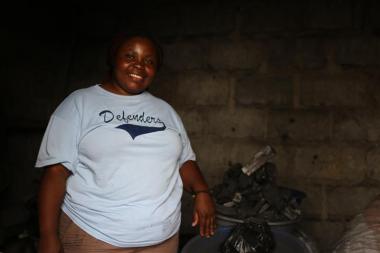
At the same time, she restarted her charcoal business. Step by step, she began earning again, buying, selling, and adapting to a difficult and unpredictable environment.
“I cannot afford to stop. Even a small income helps me take care of my children.”
Rebuilding her livelihood was not just about income. It was about independence and dignity.
“I no longer depend on anyone. I have regained my dignity as a woman and as a mother.”
Recovery, for Brigitte, has not been a solitary journey.
Within the safe space, women support one another, share experiences, and find practical ways forward. They are not only participants—they actively shape the space and what it offers.
“The best way to remain dignified is to have an income and to support each other,” says one member of the group.
Brigitte now sees herself as someone who can also support others.
“There is a proverb in my country,” she says. “When someone washes your back, you must wash your face.”
Her journey reflects a shift, from isolation to connection, and from uncertainty to renewed purpose.
Brigitte’s story is still unfolding. The challenges remain, and the broader context continues to be difficult.
But today, she is making decisions about her own life again.
Her story is not about being rescued. It is about what becomes possible when women have access to spaces where they can speak, be heard, and act together.
“I chose not to give up,” she says. “And now, I am moving forward.”
Across eastern Democratic Republic of Congo, women are coming together in safe spaces to support one another, rebuild confidence, and create pathways forward despite crisis and displacement. Through collaboration with local partners and women-led groups, ActionAid DRC supports these efforts by helping ensure access to psychosocial support, protection services, and opportunities to rebuild livelihoods. At the same time, support to education helps children, especially girls, continue learning in safer environments.
In 2025 alone, more than 3,800 women and girls accessed services through safe spaces supported across multiple locations.
These efforts go beyond service delivery. They contribute to creating conditions where women can organise, make decisions, and reclaim control over their lives.
Brigitte’s story is one of resilience—but it should not be a necessity.
Too many women and girls across eastern DRC continue to face violence, displacement, and limited access to support.
Sustained and flexible support is needed to expand safe spaces, strengthen gender-based violence response services, support women’s economic recovery, and ensure that girls can continue their education even in times of crisis.
Now is the time to act.
We call on donors, partners, and the international community to increase investment in women-led and locally driven responses, prioritise protection and education in emergencies, and commit to long-term solutions that address the root causes of violence and inequality.
Because when women like Brigitte are able to rebuild their lives with dignity and agency, they do more than recover—they help shape stronger, more resilient communities.